2
0
Support the library.
Your support helps keep books free for everyone ❤️
📍 Noticed
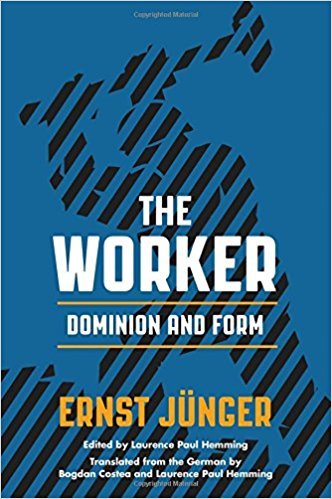
The Worker: Dominion and Form
by Ernst Jünger
Sponsored
Synopsis
Written in 1932, just before the fall of the Weimar Republic and on the eve of the Nazi accession to power, Ernst Jünger’s The Worker: Dominion and Form articulates a trenchant critique of bourgeois liberalism and seeks to identify the form characteristic of the modern age. Jünger’s ...
Written in 1932, just before the fall of the Weimar Republic and on the eve of the Nazi accession to power, Ernst Jünger’s The Worker: Dominion and Form articulates a trenchant critique of bourgeois liberalism and seeks to identify the form characteristic of the modern age. Jünger’s analyses, written in critical dialogue with Marx, are inspired by a profound intuition of the movement of history and an insightful interpretation of Nietzsche’s philosophy.
Martin Heidegger considered Jünger “the only genuine follower of Nietzsche,” singularly providing “an interpretation which took shape in the domain of that metaphysics which already determines our epoch, even against our knowledge; this metaphysics is Nietzsche's doctrine of the ‘will to power.’” In The Worker, Jünger examines some of the defining questions of that epoch: the nature of individuality, society, and the state; morality, justice, and law; and the relationships between freedom and power and between technology and nature.
This work, appearing in its entirety in English translation for the first time, is an important contribution to debates on work, technology, and politics by one of the most controversial German intellectuals of the twentieth century. Not merely of historical interest, The Worker carries a vital message for contemporary debates about world economy, political stability, and equality in our own age, one marked by unsettling parallels to the 1930s.
Martin Heidegger considered Jünger “the only genuine follower of Nietzsche,” singularly providing “an interpretation which took shape in the domain of that metaphysics which already determines our epoch, even against our knowledge; this metaphysics is Nietzsche's doctrine of the ‘will to power.’” In The Worker, Jünger examines some of the defining questions of that epoch: the nature of individuality, society, and the state; morality, justice, and law; and the relationships between freedom and power and between technology and nature.
This work, appearing in its entirety in English translation for the first time, is an important contribution to debates on work, technology, and politics by one of the most controversial German intellectuals of the twentieth century. Not merely of historical interest, The Worker carries a vital message for contemporary debates about world economy, political stability, and equality in our own age, one marked by unsettling parallels to the 1930s.
You May Also Like

The Legend of Chris Moose: The Most Beautiful Moose in the World
Allen Northcutt

Purple Rain
Joanna Balicka
Foreign Fruit: A Personal History of the Orange
Katie Goh

Being You: A New Science of Consciousness
Anil Seth

Data Pipelines Pocket Reference: Moving and Processing Data for Analytics
James Densmore

Heartstopper: Volume Five
Alice Oseman