1
0
Support the library.
Your support helps keep books free for everyone ❤️
📍 Noticed
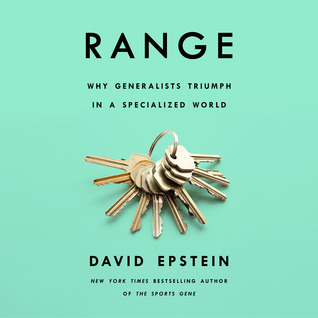
Range: Why Generalists Triumph in a Specialized World
by David Epstein
Sponsored
Synopsis
What's the most effective path to success in any domain? It's not what you think.Plenty of experts argue that anyone who wants to develop a skill, play an instrument, or lead their field should start early, focus intensely, and rack up as many hours of deliberate practice as ...
What's the most effective path to success in any domain? It's not what you think.
Plenty of experts argue that anyone who wants to develop a skill, play an instrument, or lead their field should start early, focus intensely, and rack up as many hours of deliberate practice as possible. If you dabble or delay, you'll never catch up to the people who got a head start. But if you take a closer look at the world's top performers, from professional athletes to Nobel laureates, you'll find that early specialization is the exception, not the rule.
David Epstein, author of the New York Times bestseller The Sports Gene, studied the world's most successful athletes, artists, musicians, inventors, forecasters and scientists. He discovered that in most fields--especially those that are complex and unpredictable--generalists, not specialists, are primed to excel. Generalists often find their path late, and they juggle many interests rather than focusing on one. They're also more creative, more agile, and able to make connections their more specialized peers can't spy from deep in their hyperfocused trenches. As experts silo themselves further while computers master more of the skills once reserved for highly focused humans, people who think broadly and embrace diverse experiences and perspectives will increasingly thrive.
Our obsession with getting a head start is understandable; early specialization feels efficient. But Epstein marshals an enormous body of scientific research to argue that we should all actively cultivate inefficiency. Failing a test is the best way to learn. Frequent quitters end up with the most fulfilling careers. The most impactful inventors cross domains rather than deepening their knowledge in a single area. Provocative, rigorous, and engrossing, Range explains how to maintain the benefits of breadth, diverse experience, interdisciplinary thinking, and delayed concentration in a world that increasingly incentivizes, even demands, hyperspecialization.
Plenty of experts argue that anyone who wants to develop a skill, play an instrument, or lead their field should start early, focus intensely, and rack up as many hours of deliberate practice as possible. If you dabble or delay, you'll never catch up to the people who got a head start. But if you take a closer look at the world's top performers, from professional athletes to Nobel laureates, you'll find that early specialization is the exception, not the rule.
David Epstein, author of the New York Times bestseller The Sports Gene, studied the world's most successful athletes, artists, musicians, inventors, forecasters and scientists. He discovered that in most fields--especially those that are complex and unpredictable--generalists, not specialists, are primed to excel. Generalists often find their path late, and they juggle many interests rather than focusing on one. They're also more creative, more agile, and able to make connections their more specialized peers can't spy from deep in their hyperfocused trenches. As experts silo themselves further while computers master more of the skills once reserved for highly focused humans, people who think broadly and embrace diverse experiences and perspectives will increasingly thrive.
Our obsession with getting a head start is understandable; early specialization feels efficient. But Epstein marshals an enormous body of scientific research to argue that we should all actively cultivate inefficiency. Failing a test is the best way to learn. Frequent quitters end up with the most fulfilling careers. The most impactful inventors cross domains rather than deepening their knowledge in a single area. Provocative, rigorous, and engrossing, Range explains how to maintain the benefits of breadth, diverse experience, interdisciplinary thinking, and delayed concentration in a world that increasingly incentivizes, even demands, hyperspecialization.
You May Also Like

Wild for You: A Small Town, Age Gap, Single Dad Romance (The Wilds of Montana Book 1)
Kristen Proby

Malibu Rising
Taylor Jenkins Reid

Their Bonded Love (Four Flames Saga Book 3)
Callie Madden

Criminal Law 101: Scientific Analysis of Criminal Offenses & Penalties in the Criminal Code Explained with Ease Like a Pro (Book 2). (Master Legal Terminology ... Phrases (Legal Vocabulary And Terminology))
Alexander Rothwell

Vampire Origins - Project Ichorous
Riley Banks

CULTURE
Conrad Phillip Kottak
Memoir Picks
View All
Beyond the Wand: The Magic & Mayhem of Growing Up a Wizard
Tom Felton

Things in Nature Merely Grow
Yiyun Li

Entitled: The Rise and Fall of the House of York
Andrew Lownie

The Anthropocene Reviewed: Essays on a Human-Centered Planet
John Green

This Year: 365 Songs Annotated: A Book of Days
John Darnielle

Taste: My Life Through Food
Stanley Tucci
