0
0
Support the library.
Your support helps keep books free for everyone ❤️
📍 Noticed
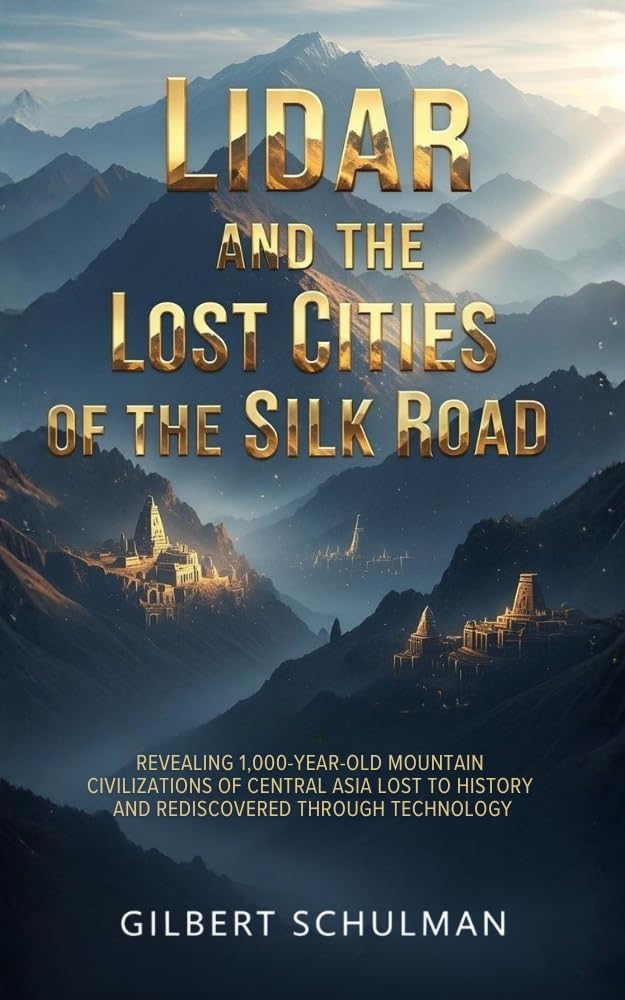
Lidar And The Lost Cities Of The Silk Road: Revealing 1,000-Year-Old Mountain Civilizations of Central Asia Lost to History and Rediscovered Through Technology
by Gilbert Schulman
Sponsored
Synopsis
For a thousand years, they were invisible. Now, they're rewriting history.
In the mountains of Central Asia, where modern visitors struggle to breathe, medieval peoples built thriving cities at elevations higher than Machu Picchu. For eight centuries, these metropolises—spanning 300 acres with ...
In the mountains of Central Asia, where modern visitors struggle to breathe, medieval peoples built thriving cities at elevations higher than Machu Picchu. For eight centuries, these metropolises—spanning 300 acres with ...
For a thousand years, they were invisible. Now, they're rewriting history.
In the mountains of Central Asia, where modern visitors struggle to breathe, medieval peoples built thriving cities at elevations higher than Machu Picchu. For eight centuries, these metropolises—spanning 300 acres with fortification walls, industrial complexes, and thousands of inhabitants—remained completely hidden from scholarship.
Then came lidar.
Using laser technology mounted on drones, archaeologists revealed what ground surveys had missed: Tugunbulak and Tashbulak, two massive highland cities that challenge everything we thought we knew about the Silk Road. Historians insisted the famous trade network flowed exclusively through lowland oases like Samarkand and Bukhara. Mountains were barriers to cross, not destinations where people built urban empires.
They were wrong.
Lidar And The Lost Cities Of The Silk Road tells the story of one of the 21st century's most significant archaeological discoveries. These weren't peripheral outposts—they were industrial powerhouses producing the steel that was the "oil of the medieval world." Their existence forces a complete reimagining of Silk Road geography, revealing a three-dimensional trade network that utilized every geographic possibility the Eurasian landmass offered.
In this groundbreaking book, you'll discover:
• How cutting-edge technology revealed cities that remained hidden for 800 years
• Why these mountain metropolises thrived at altitudes once thought impossible for urban life
• The massive metallurgical operations that made these cities economic powerhouses
• How an entire civilization could vanish so completely from historical memory
• What these discoveries reveal about human adaptation, resilience, and vulnerability
This book combines scientific rigor with compelling narrative. It's a story of technological breakthrough, scholarly humility, and the revelation that even our most confident maps of the past contain blank spaces waiting to be filled.
Perfect for anyone fascinated by how modern science continues to revolutionize our understanding of ancient civilizations.
The mountains have finally revealed their secret. The story is more remarkable than anyone imagined.
You May Also Like

The Silver Key
H.P. Lovecraft
Experiencing Architecture
Steen Eiler Rasmussen

Truman Capote: In Which Various Friends, Enemies, Acquaintances, and Detractors Recall His Turbulent Career
George Plimpton
Damned Italians: What They Don’t Know but Should
Patrick R. Lang

The Cardinal: A Novel of Love and Power
Alison Weir

Burn the Water
Billy Ray
Business Picks
View All
From Strength to Strength: Finding Success, Happiness, and Deep Purpose in the Second Half of Life
Arthur C. Brooks

Source Code: My Beginnings
Bill Gates

How to Know a Person: The Art of Seeing Others Deeply and Being Deeply Seen
David Brooks

Very Bad Company
Emma Rosenblum

Material World: The Six Raw Materials That Shape Modern Civilization
Ed Conway

The Bookshop: A History of the American Bookstore
Evan Friss
