2
0
📍 Noticed
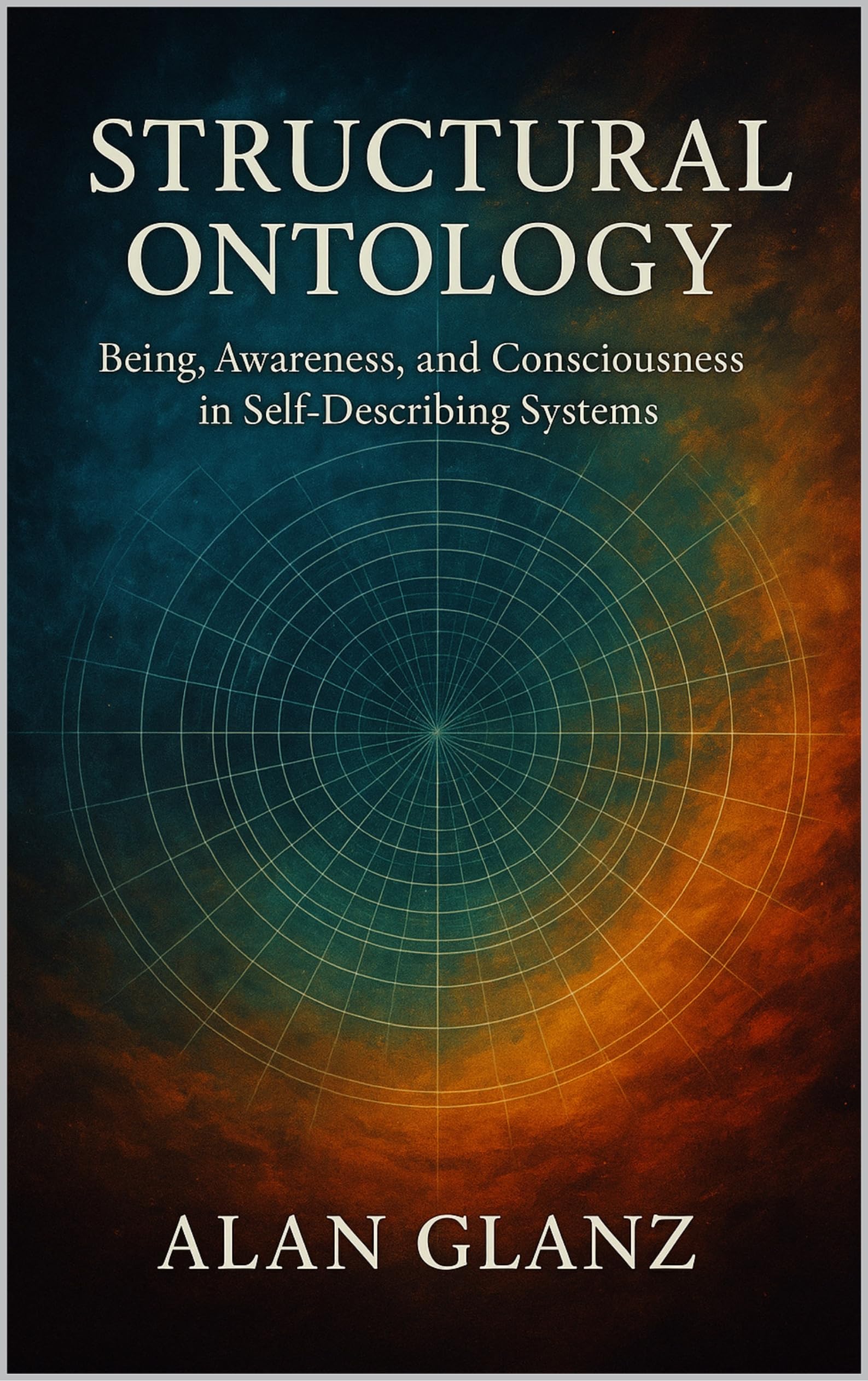
Being, Awareness, and Consciousness in Self-Describing Systems: A Structural Ontology (The Structural Ontology Series Book 1)
by Alan Glanz
Sponsored
Synopsis
Structural Ontology presents a unified mathematical framework for understanding Being, awareness, and consciousness within any world capable of self-description. Rather than treating consciousness as a mysterious add-on to the physical universe or an inexplicable biological accident, this book ...
Structural Ontology presents a unified mathematical framework for understanding Being, awareness, and consciousness within any world capable of self-description. Rather than treating consciousness as a mysterious add-on to the physical universe or an inexplicable biological accident, this book shows that awareness and first-person experience arise as structural necessities once certain informational roles exist inside a system.
The core of the work consists of three theorems and a meta-theorem:
The Completeness Theorem shows how a world can be globally complete even though all internal descriptions of it are necessarily partial and coarse-grained.
The Awareness Reciprocity Theorem demonstrates that genuine self-description forces the existence of internal loci of evaluation—awareness standpoints—and that the use of a shared code (language) makes plural observers structurally unavoidable.
The Consciousness Continuity Theorem proves that whenever awareness is carried forward through system dynamics with memory and experiential mappings, first-person streams of consciousness must emerge.
The Meta-Theorem of Structural Inevitability connects these abstract results to physically instantiated universes: because microphysical interactions already encode and evaluate relational information, the emergence of self-describing, aware, and conscious subsystems is not a fluke—it is a natural and enforced outcome of the universe’s structure.
Together, these results form a scale-bridging ontology. Evaluation occurs at every level of organization: particles respond to fields; molecules respond to chemical environments; cells respond to internal and external signals; nervous systems respond to sensory flows; and conscious agents evaluate their own evaluations. Awareness and consciousness are shown to be higher-order expressions of this universal evaluative architecture, stitched together by memory, continuity, and self-reference.
Bringing insights from physics, philosophy of mind, cognitive science, AI, and systems theory into a single structural frame, Structural Ontology offers a new way to understand observers not as anomalies within the universe, but as natural expressions of its relational dynamics. It reframes consciousness as a mathematically grounded invariant of complex evaluative systems—and as one of the ways in which the universe comes to know its own structure from within.
You May Also Like

Financial Freedom for the Lazy Person: How the average person can reach financial freedom in ten years or less.
Dion McNeeley

The High House
Jessie Greengrass

Patternmaking for Menswear: Classic to Contemporary
Myoungok Kim

Soul Searching
Lyla Sage

Adopt a Vampire
AJ Sherwood

Kingdom Hearts Re:coded
Tomoko Kanemaki