1
0
Support the library.
Your support helps keep books free for everyone ❤️
📍 Noticed
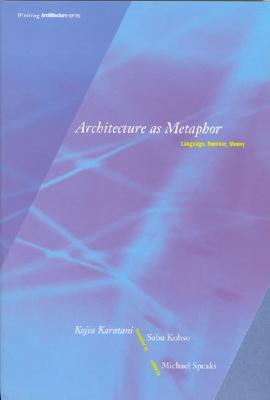
Architecture as Metaphor: Language, Number, Money (Writing Architecture)
by Kōjin Karatani
Sponsored
Synopsis
In Architecture as Metaphor, Kojin Karatani detects a recurrent will to architecture that he argues is the foundation of all Western thinking, traversing architecture, philosophy, literature, linguistics, city planning, anthropology, political economics, psychoanalysis, and mathematics. Kojin ...
In Architecture as Metaphor, Kojin Karatani detects a recurrent will to architecture that he argues is the foundation of all Western thinking, traversing architecture, philosophy, literature, linguistics, city planning, anthropology, political economics, psychoanalysis, and mathematics. Kojin Karatani, Japan's leading literary critic, is perhaps best known for his imaginative readings of Shakespeare, Soseki, Marx, Wittgenstein, and most recently Kant. His works, of which Origins of Modern Japanese Literature is the only one previously translated into English, are the generic equivalent to what in America is called theory. Karatani's writings are important not only for the insights they offer on the various topics under discussion, but also as an example of a distinctly non-Western critical intervention. In Architecture as Metaphor, Karatani detects a recurrent will to architecture that he argues is the foundation of all Western thinking, traversing architecture, philosophy, literature, linguistics, city planning, anthropology, political economics, psychoanalysis, and mathematics. In the three parts of the book, he analyzes the complex bonds between construction and deconstruction, thereby pointing to an alternative model of secular criticism, but in the domain of philosophy rather than literary or cultural criticism. As Karatani claims in his introduction, because the will to architecture is practically nonoexistent in Japan, he must first assume a dual role: one that affirms the architectonic (by scrutinizing the suppressed function of form) and one that pushes formalism to its collapse (by invoking Kurt Godel's incompleteness theorem). His subsequent discussions trace a path through the work of Christopher Alexander, Jane Jacobs, Gilles Deleuze, and others. Finally, amidst the drive that motivates all formalization, he confronts an unbridgeable gap, an uncontrollable event encountered in the exchange with the other; thus his speculation turns toward global capital movement. While in the present volume he mainly analyzes familiar Western texts, it is precisely for this reason that his voice discloses a distance that will add a new dimension to our English-language discourse.
You May Also Like

The Age of Innocence (Chiltern Classic)
Edith Wharton

Bookbindings: An Illustrated History
David Pearson

Summary Fire and Fury: Inside the Trump White House
OneHour Reads

Burning Crowns
Catherine Doyle
Capital (Das Capital): Includes Vol.1,2,3 (Fingerprint Classics)
Karl Marx
The Carb Reset: Store Less Fat, Burn the Rest, and Harness the Power of Carbs to Lose Weight
Harley Pasternak M.Sc.
Psychology Picks
View All
Tiny Experiments: How to Live Freely in a Goal-Obsessed World
Anne-Laure Le Cunff

Revenge of the Tipping Point: Overstories Superspreaders and the Rise of Social Engineering
Malcolm Gladwell

Think Again: The Power of Knowing What You Don't Know
Adam M. Grant

Fight Right: How Successful Couples Turn Conflict Into Connection
Julie Schwartz Gottman

Strong Female Character
Fern Brady

Knife: Meditations After an Attempted Murder
Salman Rushdie
