7
0
Support the library.
Your support helps keep books free for everyone ❤️
📍 Noticed
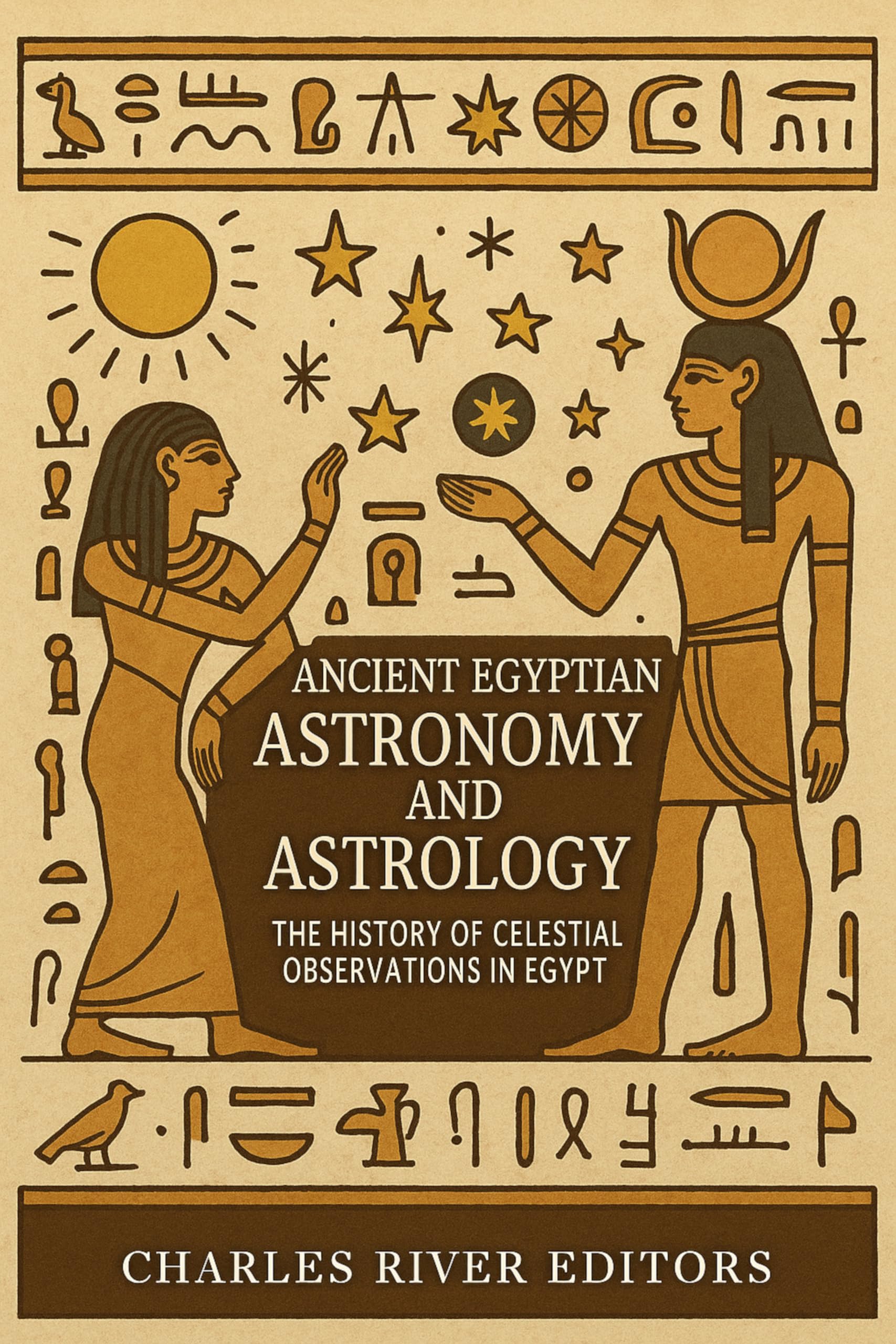
Ancient Egyptian Astronomy and Astrology: The History of Celestial Observations in Egypt
by Charles River Editors
Sponsored
Synopsis
Africa may have given rise to the first human beings, and Egypt probably gave rise to the first great civilizations, which continue to fascinate modern societies across the globe nearly 5,000 years later. From the Library and Lighthouse of Alexandria to the Great Pyramid at Giza, the ancient ...
Africa may have given rise to the first human beings, and Egypt probably gave rise to the first great civilizations, which continue to fascinate modern societies across the globe nearly 5,000 years later. From the Library and Lighthouse of Alexandria to the Great Pyramid at Giza, the ancient Egyptians produced several wonders of the world, revolutionized architecture and construction, created some of the world’s first systems of mathematics and medicine, and established language and art that spread across the known world. With world-famous leaders like King Tut and Cleopatra, it’s no wonder that today’s world has so many Egyptologists.
What makes the accomplishments of the ancient Egyptians all the more remarkable is that Egypt was historically a place of great political turbulence. Its position made it both valuable and vulnerable to tribes across the Mediterranean and the Middle East, and ancient Egypt had no shortage of its own internecine warfare. Its most famous conquerors would come from Europe, with Alexander the Great laying the groundwork for the Hellenic Ptolemy line and the Romans extinguishing that line after defeating Cleopatra and driving her to suicide.
Among the most intriguing aspects of ancient Egyptian culture is the relationship between their observations of the heavens and their beliefs about life, death, and cosmic order. While modern Egyptologists debate whether the Egyptians practiced astrology in the sense familiar to people today, it is universally acknowledged that they maintained a profound “Star Religion” from very early times. The term “Star Religion” encompasses a reverence for celestial phenomena, especially the stars, and their integration into religious ritual, calendar systems, and mythology. However, whether this system extended to linking human birth and life with celestial positions remains contentious.
Some independent researchers, such as John Anthony West, an American Egyptologist and writer, argue that the Egyptians did indeed incorporate astrology as part of their sacred science. West contends that astronomical observations were closely connected to the timing of human life and the divine order, implying that celestial patterns influenced both earthly events and the lives of individuals (Belmonte & Lull, 2023). Traditional Egyptologists, however, caution against projecting later astrological practices backward into the prehistoric or early dynastic periods of Egypt, emphasizing that surviving textual evidence primarily reflects religious and ritualistic use of celestial phenomena rather than predictive or personal astrology (Krupp, 2000).
Regardless of how they’re analyzed, from the earliest periods of their civilization, the Egyptians observed the night sky with remarkable attention to detail. Astronomical phenomena were integrated into their ritual calendar, architecture, and mythological narratives, and the brightest star visible from Earth, Sirius (known in ancient Egypt as Spdt), is mentioned as early as 2300 BCE in the Pyramid Texts, although it was undoubtedly observed much earlier. The heliacal rising of Sirius, the first visible appearance of the star at dawn after a period of invisibility, was closely associated with the annual inundation of the Nile. This flood was essential for agriculture, depositing nutrient-rich silt along the riverbanks and ensuring the survival of crops and settlements. Priests monitored the heavens to predict the timing of the flood, demonstrating an early form of practical astronomy intertwined with rituals (Krupp, 2000).
The Egyptians also observed the sun’s motion along the eastern horizon throughout the year, and by tracking the sunrise from fixed locations, such as temple courtyards, they could identify solstices and equinoxes. The sun reached its northernmost point during the summer solstice, signaling the approach of the Nile’s inundation, and its southernmost point during the winter solstice.
You May Also Like

Intimate Nude Portraits: Captivating Images Of Naked Girls
Mariah Kershaw

The Remarkable Life of the Skin: An Intimate Journey Across Our Largest Organ
Monty Lyman

My Daughter's Boyfriend
Daniel Hurst

Backstabbed in a Backwater Dungeon: My Trusted Companions Tried to Kill Me, But Thanks to the Gift of an Unlimited Gacha I Got LVL 9999 Friends and Am ... and the World: Volume 10 (Light Novel)
Meikyou Shisui
Elasticity (Solid Mechanics and Its Applications, 12)
James Richard Barber

Jack Frost: The End Becomes the Beginning (The Guardians, #5)
William Joyce
Philosophy Picks
View All
Supremacy: AI, ChatGPT, and the Race That Will Change the World
Parmy Olson

The Cat Who Taught Zen: A Beautifully Illustrated Exploration of Self-Discovery
James Norbury

The Boy, The Mole, The Fox and The Horse - The Animated Story
Charlie Mackesy

Always Remember: The Boy, the Mole, the Fox, the Horse and the Storm
Charlie Mackesy

The Creative Act: A Way of Being
Rick Rubin

Slow Productivity: The Lost Art of Accomplishment Without Burnout
Cal Newport
